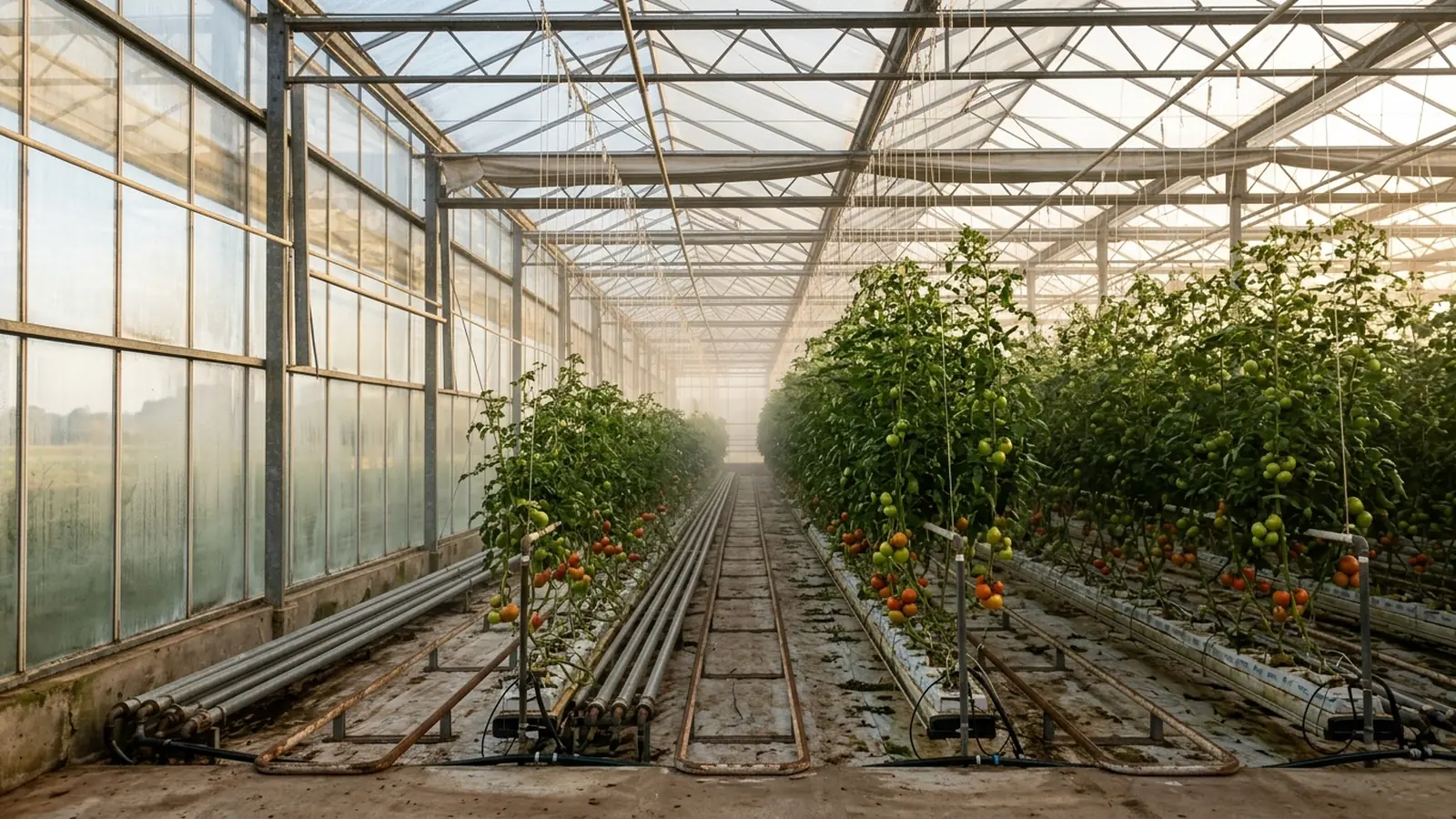
As of October 2026, heated glasshouse growers are not part of the British Industrial Competitiveness Scheme (BICS), the new electricity discount for manufacturers. The scheme’s guidance is written for manufacturing businesses, and the parts of it I could check do not mention horticulture or glasshouses. The route that does exist for many growers is the Climate Change Agreement, which cuts the Climate Change Levy on your energy. It runs through sector bodies and has fixed entry windows, so the next step is to check your eligibility with them.
What BICS is and who it covers
BICS is an electricity relief scheme for manufacturers. It removes some indirect charges from eligible firms’ bills, including the Renewables Obligation and Feed-in Tariffs from April 2027 and the Capacity Market from October 2027. The government describes the saving as up to 25%, or up to £40 per megawatt hour.
Eligibility depends on four things:
- the business is registered at Companies House
- at least one of its registered activity codes is in the eligible sectors
- it makes eligible products in Great Britain
- each manufacturing site uses at least 33 MWh of grid electricity a year
Applications open on 1 October 2026 and close at 11:59pm on 30 November 2026. Decisions are expected in early 2027.
The November 2025 announcement said more than 7,000 businesses would benefit. The NFU later reported that the scheme had been expanded to more than 10,000 manufacturers.
Why glasshouse growers were left out
I could not find an official reason in the government material I checked. In the House of Commons, an MP argued that glasshouse growers use a lot of electricity and gas but are not treated as energy-intensive. The NFU, which represents farmers, responded in April 2026 that the government had missed a chance to help food producers.
NFU President Tom Bradshaw said heated growers of tomatoes, cucumbers and peppers face the same global price swings as factories. The NFU wants the eligibility rules reviewed and the increases to standing charges reconsidered. It has also warned that some growers may stop producing if costs stay high. Those are the NFU’s positions, not a government commitment, and no change to the scheme had been announced in the sources I found.
The Climate Change Agreement route
A Climate Change Agreement (CCA) is a voluntary deal. A site in an eligible sector agrees to energy efficiency targets, and in return it pays much less Climate Change Levy (CCL), the charge added to business use of electricity, gas and LPG.
The main CCL rates from 1 April 2026 are:
| Fuel | Main CCL rate | Rate for CCA holders |
|---|---|---|
| Electricity | 0.801p per kWh | 8% of the main rate, about 0.064p per kWh |
| Natural gas | 0.801p per kWh | 11% of the main rate, about 0.088p per kWh |
| LPG | 2.175p per kg | 23% of the main rate, about 0.500p per kg |
The reduced rates are the government’s percentages; the pence figures are my calculation from them. Put simply, an agreement holder pays about 92% less levy on electricity and about 89% less on gas.
Can a glasshouse join?
A 2025 government announcement for a new phase of the scheme included horticulture, according to trade reports from NFU Energy and GrowSave. The 2026 Environment Agency guidance does not list sectors, so confirm your own position with your sector body before you plan around it.
The timing is the tricky part. The guidance says new entrants can join an existing umbrella agreement only between 1 January and 31 August in each year from 2026 to 2029. The 2026 window has already closed, so the next one for existing umbrella agreements runs from 1 January to 31 August 2027. Facilities in sectors newly added to the scheme need the regulations to be changed first, and a separate window will be announced.
What to do now
- Check your levy line. Look at your last twelve months of gas, electricity and LPG bills. If you see the full levy charged, you are not in an agreement.
- Ask about your standing charges. The NFU says the steepest rise in standing charges took effect in April 2026. Ask your supplier to show you how your charges have changed.
- Ask your sector body. Trade reports say NFU Energy has handled Climate Change Agreement applications for growers. Ask whether your glasshouse can join an umbrella agreement and when the next window opens.
- Keep your energy records. Agreement holders have to report energy use and meet efficiency targets, so good records from the start make the process easier.
- Review your contract. Check the end date and terms of your supply deal before the next renewal. A broker or energy adviser can compare offers for a business site.
- Look at your heating and glazing. Screens, glazing and heating controls often affect fuel use more than the tariff does. An energy audit can show where the largest savings are.
Key points
- BICS is for manufacturers. As of October 2026, its guidance does not cover glasshouse growers.
- BICS applications run from 1 October to 30 November 2026, with the discount starting in 2027.
- The Climate Change Agreement route cuts the levy by about 92% on electricity and about 89% on gas for holders.
- The 2026 new-entrant window closed on 31 August. The next one is 1 January to 31 August 2027.
- Confirm your eligibility with your sector body before making plans.
Frequently asked questions
Can my greenhouse apply for BICS? Not on the basis of the guidance I checked, which is written for manufacturers. If your business also makes a manufactured product that is on the eligible list, speak to the scheme team before deciding.
Do I pay Climate Change Levy at all? Yes, unless you are in a Climate Change Agreement or another exemption applies. The levy is charged on business use of electricity, gas and LPG.
When can I next join a Climate Change Agreement? For existing umbrella agreements, the guidance sets the window as 1 January to 31 August each year from 2026 to 2029. The next window is in 2027.
Is the NFU still pushing for growers to get electricity relief? Yes. Its April 2026 statement called for a review of the eligibility rules and of the standing charge increases.
Should I get professional advice? Yes. Energy contracts, agreement eligibility and any future support rules are complex, and the rules can change. A sector body, a business energy adviser or an accountant can check your exact position.
Where to go for help
Fertile Land Ltd, a London-based agricultural consultancy, says on its website that it offers greenhouse and crop management consulting, plus business plans for greenhouse projects. For Climate Change Agreement eligibility and energy contracts, though, start with your sector body and your supplier.